
“THIS IS HOME” Kate Adams and Duke Wiser, owners of Beaverkill Meadows Farm, flank the farm’s manager, Benjamin Doland, The 500-acre farm operates without commercial fertilizer or pesticides. Kara Didrich photo
One Manor family’s ‘miracle’
Local farm an ecological model
By Kara Didrich | Manor Ink
Livingston Manor, NY – What an amazing place, soon to be open for all to visit, just a couple of miles from downtown Livingston Manor. Hidden by trees and a long entry drive, it is revealed to be an inspiring and productive farm oasis. The view at the top of the drive includes expansive rolling fields, woods and trees, gardens, multiple refurbished barns and buildings, beautiful horses, cows and more.
This is the Beaverkill Meadows Farm. A 500-acre working farm, it has a hands-on, live-in crew who are very invested in their work. Farm Manager Benjamin Doland introduced Manor Ink to another part of the team, the American draft horses Velvet and Blue, residing in an immaculate stable.
SOLAR POWERED The farmhouse at Beaverkill Meadow Farm has all been restored and refurbished. Much of the farm’s electricity is generated by roof-mounted solar panels. Kara Didrich photo
Beef, eggs, fruit, nuts and more
The farm primarily raises Belted Galloway cows, a traditional Scottish breed of cattle bred for beef, and has been growing the herd, now about 80 head. They also have over 100 chickens producing eggs to sell. There is a 45-acre blueberry patch, and numerous fruit trees in the process of maturing. A plant nursery has been established in order to grow edible perennial plants, including berries, nuts, roots and edible leaves, as well as native plants people can use for landscaping. Annual crops are also grown for the purpose of generating seeds to sell so people can plant and cultivate plants on their own.
“This is home,” said Kate Adams, the co-owner of Beaverkill Meadows Farm with her husband Duke Wiser. “Our family is really committed to this area. I wake up every day and say, ‘How did this miracle happen?’” The couple has genuine enthusiasm for the farm and has expanded the property since acquiring the original farm from Dave Collins. Collins now has life tenancy in a passive solar house built for him on the property, a structure which also provides sufficient electricity to power the entire farm.
“The quality of the fields is amazing. We don’t use fertilizer, we don’t use pesticides, we don’t use anything at all, except a little bit of lime the fields.” The couple plans to continue using sustainable agriculture practices. Their cattle consume field grass, hay from local farms, or they forage in the woods.
”Why we chose Belted Galloway – first of all, they’re beautiful. But they are Highland cattle, and are used to really bad weather,” said Adams.
All in the family
“BEAUTIFL” Beaverkill Meadows Farm is home to a herd of striking Belted Galloway cows – named for an obvious reason. Provided photo
The farm is a family affair with deep roots in the community. Adams’ parents, John and Patricia Adams, have maintained a house in Beaverkill for decades, and currently live there. Their children, including Kate, were raised here and in New York City. John Adams was born in Roscoe. As Kate grew up, she inherited the fondness for the area. She attended Livingston Manor Central School for first grade before moving to New York City where her parents pursued the founding of The Natural Resources Defense Council. Her father also founded the Open Space Institute which is well known and respected in the lower Hudson Valley region. Kate Adams’ two brothers, along with several cousins, live in the area as well.
Adams’ and Wiser’s son, Woods Wiser, a chemical engineer by education, is a self-described “plant nerd” and leads the development of the farm’s plant nursery. “This year will be the first year we have a lot to offer, and will actively make available produce for sale online and at farmstands,” said Woods. The nursery can be seen along Old Rte. 17, surrounded by deer fencing. “There will also be a large pumpkin patch this year,” he said.
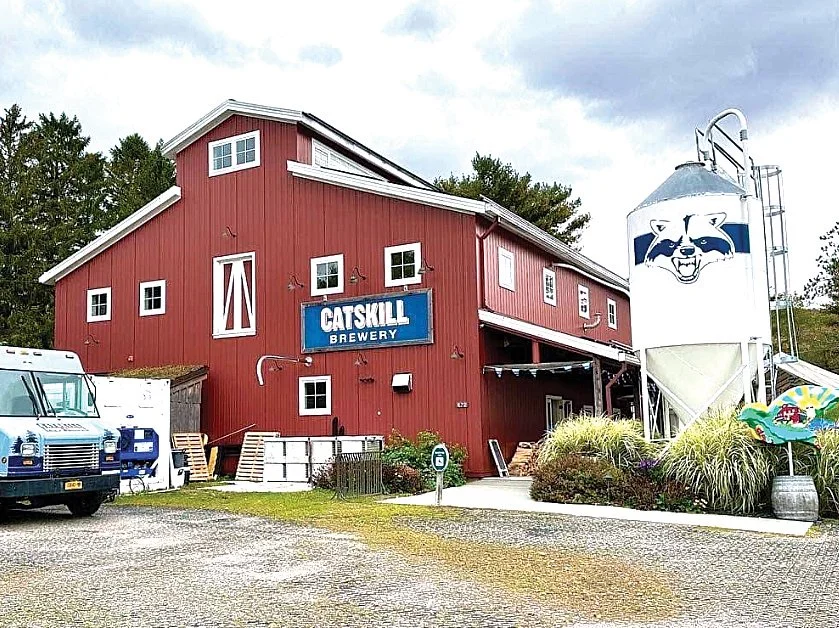
This year marks an important milestone, because Kate Adams plans on retiring and settling full-time in the Beaverkill Valley along with Wiser who will run the Catskill Brewery on Old Rte. 17 in the Manor. They plan to open the farm for community events and a pick-your-own blueberry patch. In addition, they plan to partner with Somewhere In Time Farm and perhaps others to sell produce and plants at a farm stand that will hopefully be opening sometime in the summer at the Catskill Brewery.
UPGRADED The refurbished barns at Beaverkill Meadows Farm. Kara Didrich photo
Taking on management of the Catskill Brewery, too
Provided photo
Kate Adams and Duke Wiser, the couple behind Beaverkill Meadows Farm on Beaverkill Road, have become majority owners of Catskill Brewery, one of Livingston Manor’s artisanal beer brewers, located on Old Rte. 17..
The couple are not newcomers to the business. They had previously invested financially in the brewery and supported its mission, but until now had remained largely behind the scenes.
The transition comes as longtime brewery founder Randy Lewis – credited with helping establish the brewery’s sustainability-focused identity and LEED-certified facility – steps back from day-to-day ownership.
According to Wiser, the brewery’s staff structure will remain in place, with brewing, sales and front-of-house leadership continuing to operate while reporting to Wiser. The acquisition may also forge ties between the brewery and Beaverkill Meadows Farm.
Adams said the couple hopes to establish a modest farm stand at the brewery this summer, featuring produce, meat and horticultural products developed in partnership as well with other local farmers.
“We’re really hoping to build the farm store out and have that be part of the brewery,” Wiser said. “You can pick up your vegetables and your meat ... and get a beer, or get a non-alcoholic beer.”
The brewery itself may soon see physical changes as well. Adams said the back taproom space, currently occupied by offices, could open to the public later this summer, creating a larger communal gathering area.